The very first gaming session was in some respects the least interesting, even though we covered two rounds of progress. I say this not because the concept wasn't good, and I don't mean to suggest that the Players weren't keen to sink their teeth into such an unusual concept. I merely mean that none of us had any idea what to expect from a campaign of this kind — its scope, its magnitude, its complexity. We didn't know what kind of consequences we might face. I didn't have a good notion how even to prepare such a campaign, because as far as I knew, nobody had ever tried anything like it.
Since we had to cover two rounds of the game in one night, it meant I had to prepare Round 1, Year Zero with a limited palette of consequences. I imagined various cultural forces which might come into conflict, such as curiosity, mysticism, tradition, medicine, discipline, fear of the unknown, and pit them against each other in what I hoped were relative binary ways. Either mysticism would win, I expected, or rationality would. I was prepared for either contingency, with a string of if-then statements woven into my preparatory materials. If the players chose to do X, I would follow up with Scenario B, and so on.
I hadn't anticipated the dedication to which my apparently Taoist campaigners consistently sought the Middle Path.
Players
Joe: the host of our gaming nights, my best friend for 25 years, and the Leader of the triumvirate.
Dave: a friend of several years, whom I met while doing a play for a local theater company. He would play the Artisan.
Connor: a friend and co-worker of Dave's who had been incorporated into our gaming group; his role was the Mystic.
Year Zero: The Earth Gathering
The Dar tribe loses their leader and their medicine man as a result of an earthquake which destroys their cave. The survivors seek answers, blaming a deformed six-fingered child of Uman, but the Great Spirits deny them justice. In fact, the Great Spirits insist that the Dar offer up one of their women to Uman's deformed child as a bride when he comes of age. A Dar midwife, their only remaining healer, attacks Uman in her rage and despair and is killed.
The six-fingered son of the Uman tribe is allowed to live despite his obvious mutation, and no special mystical significance is attributed to the earthquake. The Uman boy is prophesied to become a great leader and wizard, and is promised a bride of the Dar people when he comes of age.
The curiosity of the Pagh toward the reason for the earthquake leads them on a quest into the mountains, to learn why the earth moves. Perhaps the Earth has rising and falling cycles, as do the Sea and the River.
The Kufu are encouraged to add a medicine man to their tribe, and take on Tor the Sage of the Pagh. They return to their ancestral lands with a renewed appreciation for the value of strong medicine.
The Brun warn that although the sign of the earthquake is meaningless, the sign of the lunar eclipse is worse. Their fears are ignored. The Brun return to their cold northern lands, unsatisfied.
Year 30,000: Hominid Migration
The Drim Acquire A Telepath. The tradition of bridal exchange is interrupted when the Drim suspect a young healer to be possessed by evil spirits. The Great Spirits demonstrate that her telepathy is actually beneficial, for young Temu is the equal of old Ral the Raven in a contest of skills.
The Mannut Discover Mining. The Mannut tribe discovers a copper deposit when an avalanche destroys their cave. Nobody is harmed, but the Great Spirits warn that any further investigation into the stones of the earth would require the presence of a skilled shaman.
The Abequa Enter The Great Valley. After wandering for millennia in the high mountain passes where food is scarce, the migrating Abequa reach a valley where flora is lush and fauna is unimaginably plentiful. The sudden surplus almost crumbles the discipline within the tribe, and there is a crisis of leadership. Only Jebba the Healer can bring back the mighty huaca alive. Reluctantly, she accepts that it is her Quest to lead her people, for among all of the Eagle tribe, she is best suited for the task.
The Ayuté Have Two Toolmakers. When Noves, toolmaker of the Ayuté, is killed by a tiger, the tribe looks to his son Novan to fill the role of craftsman, though he has not the skill of his father. There is a challenge from Faya, even younger than he but no less adept at making weapons in her own particular style. When the two types of weapons are put to the test, the women of the tribe are far more successful catching fish than are the men, and the balance of power in the tribe begins to shift.
The Cleansing Ritual Of Oparron. A tribe is being pushed farther out onto a rain-lashed peninsula, where food is scarce and tempers are frayed. Discipline can no longer be maintained, and some hungry tribesmen secretly hunt for crabs on the seashore, without bothering to share their bounty. After three people die from shellfish allergy, a phenomenon the Oparron are not equipped to understand, the Great Spirits are there to help. The eating of crab meat is a rite of passage all must undergo, to determine if one is strong enough to suit the needs of the tribe. A grisly pyrophiliac cleansing ritual is invented as a purifying rite for the bodies of those slain. Soon after this, the Oparron advance out across the lowlands and onto the island chain that spans the North Ocean.
Showing posts with label round-2. Show all posts
Showing posts with label round-2. Show all posts
Thursday, January 13, 2011


The Brun Clans
A Timeline of Events in the History of the Brun Clans
Rounds 1 and 2: The Paleolithic Era
Year Zero: The Earth Gathering. The Brun warn that although the sign of the earthquake is meaningless, the sign of the lunar eclipse is worse. Their fears are ignored. The Brun return to their cold northern lands, unsatisfied.
Year 30,000: The Cleansing Ritual Of Oparron. A tribe is being pushed farther out onto a rain-lashed peninsula, where food is scarce and tempers are frayed. Discipline can no longer be maintained, and some hungry tribesmen secretly hunt for crabs on the seashore, without bothering to share their bounty. After three people die from shellfish allergy, a phenomenon the Oparron are not equipped to understand, the Great Spirits are there to help. The eating of crab meat is a rite of passage all must undergo, to determine if one is strong enough to suit the needs of the tribe. A grisly pyrophiliac cleansing ritual is invented as a purifying rite for the bodies of those slain. Soon after this, the Oparron advance out across the lowlands and onto the island chain that spans the North Ocean.
Year 50,000: The Bellaron Sacrifice Chamandra. When a hotheaded youth arises in the Bellaron tribes, claiming to be immortal and promising his people have nothing to fear from the rising oceans, the tribes are tempted to remain behind and not migrate to the mainland. Chamandra is sacrificed to the gods in the cleansing ritual.
For a full rendering of the game's timeline, start here with the Stone Age, or here for the Bronze Age.
Year Zero: The Earth Gathering. The Brun warn that although the sign of the earthquake is meaningless, the sign of the lunar eclipse is worse. Their fears are ignored. The Brun return to their cold northern lands, unsatisfied.
Year 30,000: The Cleansing Ritual Of Oparron. A tribe is being pushed farther out onto a rain-lashed peninsula, where food is scarce and tempers are frayed. Discipline can no longer be maintained, and some hungry tribesmen secretly hunt for crabs on the seashore, without bothering to share their bounty. After three people die from shellfish allergy, a phenomenon the Oparron are not equipped to understand, the Great Spirits are there to help. The eating of crab meat is a rite of passage all must undergo, to determine if one is strong enough to suit the needs of the tribe. A grisly pyrophiliac cleansing ritual is invented as a purifying rite for the bodies of those slain. Soon after this, the Oparron advance out across the lowlands and onto the island chain that spans the North Ocean.
Year 50,000: The Bellaron Sacrifice Chamandra. When a hotheaded youth arises in the Bellaron tribes, claiming to be immortal and promising his people have nothing to fear from the rising oceans, the tribes are tempted to remain behind and not migrate to the mainland. Chamandra is sacrificed to the gods in the cleansing ritual.
The Kufu Clans
A Timeline of Events in the History of the Kufu Clans
Rounds 1 and 2: The Paleolithic Era
Year Zero: The Earth Gathering. The Kufu are encouraged to add a medicine man to their tribe, and take on Tor the Sage of the Pagh. They return to their ancestral lands with a renewed appreciation for the value of strong medicine.
Year 30,000: The Ayuté Have Two Toolmakers. When Noves, toolmaker of the Ayuté, is killed by a tiger, the tribe looks to his son Novan to fill the role of craftsman, though he has not the skill of his father. There is a challenge from Faya, even younger than he but no less adept at making weapons in her own particular style. When the two types of weapons are put to the test, the women of the tribe are far more successful catching fish than are the men, and the balance of power in the tribe begins to shift.
The Teyo Nami And The Moon Tiger. When the moon tiger confronts the people of Teyo Nami, separating their souls and frightening the people, the players are called in to destroy it. The question of placing the souls back into their rightful bodies, however, they leave up to the tribe.
For a full rendering of the game's timeline, start here with the Stone Age, or here for the Bronze Age.
Year Zero: The Earth Gathering. The Kufu are encouraged to add a medicine man to their tribe, and take on Tor the Sage of the Pagh. They return to their ancestral lands with a renewed appreciation for the value of strong medicine.
Year 30,000: The Ayuté Have Two Toolmakers. When Noves, toolmaker of the Ayuté, is killed by a tiger, the tribe looks to his son Novan to fill the role of craftsman, though he has not the skill of his father. There is a challenge from Faya, even younger than he but no less adept at making weapons in her own particular style. When the two types of weapons are put to the test, the women of the tribe are far more successful catching fish than are the men, and the balance of power in the tribe begins to shift.
The Teyo Nami And The Moon Tiger. When the moon tiger confronts the people of Teyo Nami, separating their souls and frightening the people, the players are called in to destroy it. The question of placing the souls back into their rightful bodies, however, they leave up to the tribe.
Note: the intervening years will be filled in as I have time. Watch this space!
Year 105,748: The Haesonian Dialogue. As the Conqueror invades Zefar, society is beginning to splinter. General Drurich is sent to recruit the Haesonian soldiers to the imperial cause — or destroy them if they refuse. The Pagh Clans
A Timeline of Events in the History of the Pagh Clans
Rounds 1 and 2: The Paleolithic Era
Year Zero: The Earth Gathering. The curiosity of the Pagh toward the reason for the earthquake leads them on a quest into the mountains, to learn why the earth moves. Perhaps the Earth has rising and falling cycles, as do the Sea and the River.
Year 30,000: The Abequa Enter The Great Valley. After wandering for millennia in the high mountain passes where food is scarce, the migrating Abequa reach a valley where flora is lush and fauna is unimaginably plentiful. The sudden surplus almost crumbles the discipline within the tribe, and there is a crisis of leadership. Only Jebba the Healer can bring back the mighty huaca alive. Reluctantly, she accepts that it is her Quest to lead her people, for among all of the Eagle tribe, she is best suited for the task.
Year 50,000: The Hybesh Valley Is Burning. Two distinct tribes of the Abequa have evolved: the Ascenders, who are strong climbers, and the Leapers, who appear to be developing the capacity for gliding between the treetops. The two tribes disagree how to handle the raging forest fires that are consuming their valley — is it their quest to stay and guard the trees, or to follow the herds? The players elect to send the tribes in both directions at once.
Note: the intervening years will be filled in as I have time. Watch this space!
Year 105,618: The Pharaoh Takes A Bride. The female Matriarch of the Alvian was the first Pharaoh of the Dynasty of Sathad-Zin. Since the people of Sathad weren't accustomed to being ruled by a woman, she had taken on the illusory appearance of a winged male instead, because that was the custom of the Sathad. When it came time to produce an heir, she found herself in a pickle: she would not marry her brother, in the Sathadi style, and she could not marry the brides that the Sathadi families were offering in their custom of bridal exchange. Alvatheu elected instead to have the child herself.
Year 106,129: The Aquiline Republic Is Founded. The four races of the Great Valley build a government based on the model of the Bronze Empire.
For a full rendering of the game's timeline, start here with the Stone Age, or here for the Bronze Age.
Year Zero: The Earth Gathering. The curiosity of the Pagh toward the reason for the earthquake leads them on a quest into the mountains, to learn why the earth moves. Perhaps the Earth has rising and falling cycles, as do the Sea and the River.
Year 30,000: The Abequa Enter The Great Valley. After wandering for millennia in the high mountain passes where food is scarce, the migrating Abequa reach a valley where flora is lush and fauna is unimaginably plentiful. The sudden surplus almost crumbles the discipline within the tribe, and there is a crisis of leadership. Only Jebba the Healer can bring back the mighty huaca alive. Reluctantly, she accepts that it is her Quest to lead her people, for among all of the Eagle tribe, she is best suited for the task.
Year 50,000: The Hybesh Valley Is Burning. Two distinct tribes of the Abequa have evolved: the Ascenders, who are strong climbers, and the Leapers, who appear to be developing the capacity for gliding between the treetops. The two tribes disagree how to handle the raging forest fires that are consuming their valley — is it their quest to stay and guard the trees, or to follow the herds? The players elect to send the tribes in both directions at once.
Note: the intervening years will be filled in as I have time. Watch this space!
Year 105,618: The Pharaoh Takes A Bride. The female Matriarch of the Alvian was the first Pharaoh of the Dynasty of Sathad-Zin. Since the people of Sathad weren't accustomed to being ruled by a woman, she had taken on the illusory appearance of a winged male instead, because that was the custom of the Sathad. When it came time to produce an heir, she found herself in a pickle: she would not marry her brother, in the Sathadi style, and she could not marry the brides that the Sathadi families were offering in their custom of bridal exchange. Alvatheu elected instead to have the child herself.
Year 106,129: The Aquiline Republic Is Founded. The four races of the Great Valley build a government based on the model of the Bronze Empire.
The Uman Clans
A Timeline of Events in the History of the Uman Clans
Rounds 1 and 2: The Paleolithic Era
Year Zero: The Earth Gathering. The six-fingered son of the Uman tribe is allowed to live despite his obvious mutation, and no special mystical significance is attributed to the earthquake. The Uman boy is prophesied to become a great leader and wizard, and is promised a bride of the Dar people when he comes of age.
Year 30,000: The Mannut Discover Mining. The tribe discovers a copper deposit when an avalanche destroys their cave. Nobody is harmed, but the Great Spirits warn that any further investigation into the stones of the earth would require the presence of a skilled shaman.
Year 50,000: Exile Of The Swift Hand tribe. When the Swift Hand tribe breaks the rule against mining without the supervision of a shaman, they are exiled into the Caverns of the Silver Serpent. It is not an inviting place, so their tribesmen are generous and give them rock goats to keep them company.
For a full rendering of the game's timeline, start here with the Stone Age, or here for the Bronze Age.
Year Zero: The Earth Gathering. The six-fingered son of the Uman tribe is allowed to live despite his obvious mutation, and no special mystical significance is attributed to the earthquake. The Uman boy is prophesied to become a great leader and wizard, and is promised a bride of the Dar people when he comes of age.
Year 30,000: The Mannut Discover Mining. The tribe discovers a copper deposit when an avalanche destroys their cave. Nobody is harmed, but the Great Spirits warn that any further investigation into the stones of the earth would require the presence of a skilled shaman.
Year 50,000: Exile Of The Swift Hand tribe. When the Swift Hand tribe breaks the rule against mining without the supervision of a shaman, they are exiled into the Caverns of the Silver Serpent. It is not an inviting place, so their tribesmen are generous and give them rock goats to keep them company.
The Dar Clans
A Timeline of Events in the History of the Dar Clans
Rounds 1 and 2: The Paleolithic Era
Year Zero: The Earth Gathering. The Dar tribe loses their leader and their medicine man as a result of an earthquake which destroys their cave. The survivors seek answers, blaming a deformed six-fingered child of Uman, but the Great Spirits deny them justice. In fact, the Great Spirits insist that the Dar offer up one of their women to Uman's deformed child as a bride when he comes of age. A Dar midwife, their only remaining healer, attacks Uman in her rage and despair and is killed.
Year 30,000: The Drim Acquire A Telepath. The tradition of bridal exchange is interrupted when the Drim suspect a young healer to be possessed by evil spirits. The Great Spirits demonstrate that her telepathy is actually beneficial, for young Temu is the equal of old Ral the Raven in a contest of skills.
Year 50,000: The Thrian Telepath Chooses. Bonna, the telepath of the Blue Water tribe, is told by the Four Heroes to use her best judgment. She decides that her people of the Blue Water should not slaughter and kill the half-breed aguen people of Cold Cave. Instead, her tribe slaughters the herds of the Big River.
Note: The intervening years will be filled in as I have time. Watch this space!
For a full rendering of the game's timeline, start here with the Stone Age, or here for the Bronze Age.
Year Zero: The Earth Gathering. The Dar tribe loses their leader and their medicine man as a result of an earthquake which destroys their cave. The survivors seek answers, blaming a deformed six-fingered child of Uman, but the Great Spirits deny them justice. In fact, the Great Spirits insist that the Dar offer up one of their women to Uman's deformed child as a bride when he comes of age. A Dar midwife, their only remaining healer, attacks Uman in her rage and despair and is killed.
Year 30,000: The Drim Acquire A Telepath. The tradition of bridal exchange is interrupted when the Drim suspect a young healer to be possessed by evil spirits. The Great Spirits demonstrate that her telepathy is actually beneficial, for young Temu is the equal of old Ral the Raven in a contest of skills.
Year 50,000: The Thrian Telepath Chooses. Bonna, the telepath of the Blue Water tribe, is told by the Four Heroes to use her best judgment. She decides that her people of the Blue Water should not slaughter and kill the half-breed aguen people of Cold Cave. Instead, her tribe slaughters the herds of the Big River.
Note: The intervening years will be filled in as I have time. Watch this space!
Year 105,618: The Pharaoh Takes A Bride. The female Pharaoh, first of the dynasty of Sathad-Zin, cannot take a bride; instead, she becomes one. Volunteered as the father to produce an heir for the Sathad-Zin is Dave, the Fire God.
Year 105,710: A Conqueror is born. The trial of Dytoclanes elevates his philosophical teachings on Truth and Goodness to the status of art. His student, Attades, takes this a step further and declares that in order to do good, one must do harm. The most prolific student of Attades is Celestrones the Conqueror.
Year 105,739: The Celestrian Code of Laws. Celestrones destroys the Great Temple and all but five of the statues of the gods. In its place he builds a courthouse.
Year 105,743: The Conqueror Turns East. Before the Conqueror left for his invasion of Zefar, he had to decide how to handle the Sathad-Zin giants at his back.
Year 105,742: War Between Celestria and Zefar. The bronze-clad armies of Zefar are unprepared to meet the iron of the Conqueror. A change of tactics is desperately called for, lest the Zefari be buried by the Celestrians.
Year 105,743: The Conqueror Turns East. Before the Conqueror left for his invasion of Zefar, he had to decide how to handle the Sathad-Zin giants at his back.
Year 105,742: War Between Celestria and Zefar. The bronze-clad armies of Zefar are unprepared to meet the iron of the Conqueror. A change of tactics is desperately called for, lest the Zefari be buried by the Celestrians.
Year 106,072: The Abbadar Found Boladine. In order to quell the fears of their Oracles, the Boladine leader's son Rolojer marries both of the twins, rather than just one.
Year 30,000: The Cleansing Ritual Of Oparron (Brun)

Previous history
In the intervening millennia, the Brun — always a tribe of colder climates — migrated north and spread out across the coastal plains. Competition for game became greater as their numbers increased, pushing some of the Brun out onto a cold, marshy, wind-lashed peninsula (orange arrow). The seas were lower in those days, so a mid-oceanic tectonic ridge took on the appearance of an archipelago, and low-elevation tidal flats made interconnected land masses out of what would, in twenty thousand years' time, be islands.
The Brun, now called the Oparron, are accustomed to following herds of game, but food has become scarce on the peninsula. Stronger tribes are forcing them out of the good hunting grounds. Lately, especially during Round 2, they have turned to fishing to support their tribe, and what little fish that is caught is shared by all. Rationing, such as it might be called in the Paleolithic, was rigidly enforced. The safety of the tribe, their ability to resist encroachment by other tribes, depended on strength in numbers.
One rainy evening during , three of the Oparron discovered a way to capture several scuttling crabs on the sandy beach. They roasted the crab secretly, away from the rest of the tribe, and ate them. Almost immediately thereafter, those tribesmen died horribly: they were gasping for breath, their faces red and blotchy, and they were gabbling on about their impending doom.
The leader of the tribe is Zoad the Axe (M). He wonders if the crabs are simply poisonous. It wouldn't be the first time the tribes had discovered inedible foods. His medicine man, Olar the Mystic (M), declares that it's something in the crabs which is poisonous, possibly because they come from the salt sea. If he were to cleanse the crab meat with his Purify Water spell, perhaps it would be safe.
The explanation doesn't sit well with the overzealous enforcer, Javez the Huntress (F). She says they got what was coming to them. It was their punishment by the gods for failing to share the meat that they caught. Let that be a lesson to all!
Zoad the Axe has summoned the Great Spirits for answers.
What The Players Decided
As soon as I had described the symptoms of the tribesmen's death, Joe the Leader (who is a nurse) muttered sarcastically, "Great, now we have to invent Benedryl." He had spotted quickly, as I had suspected he would, the symptoms of an acute allergic reaction to shellfish.
Originally I had intended for this to be a way of establishing dietary law. It would not surprise me to learn that the rules of kosher and halal each stem from a rational, logical warning against certain types of foods and methods of preparation, the Bronze Age equivalent to "wash the cutting board before you start." I had also mused that the Players might take action here to purge the tribe of those members with an allergy, which might later preclude the birth of someone important. Those were just vague plans, and I hadn't formulated anything specific. Fortunately, they handed me a gift on a silver platter, as Players sometimes do: they gave me a direction that was much more interesting than the one I'd thought of.
"First of all, that shaman guy, that's not going to work," said Joe the Leader. "Purify Water? That's not going to make the crabs hypoallergenic. Connor, can you teach them a Neutralize Poison spell or something?"
"Uh... I don't have it," Connor said.
"What spells do you have? No Tell Time, no Neutralize Poison..."
It was true. I had decided that a Neutralize Poison spell hadn't been invented by this stage in the Paleolithic. Connor hadn't taken it because he wasn't allowed.
"If we agree with the Huntress," said Dave the Artisan sagely, "she's going to go on a power trip. She'll love that, being able to crack down on everybody. We don't want that to happen."
"Can we lead them off of this peninsula?" asked Joe the Leader.
They're not really strong enough to battle the other tribes, I said. That's why they're here.
"We could help them. But they'd probably still lose a few, and they've already lost three." Joe considered it. "But they have to eat something. How many more would they lose if we just had them all eat some crab?"
I shrugged. Try it and see.
Eventually they came around to this idea, but as I remember it, they took some time getting there. In the meantime, Connor the Mystic busied himself inventing a new ritual for the Oparron. The bodies of the dead who had been poisoned by the crab, he said, should be cleansed. Burn bodies, and boil the skulls—
"Connor, what are you doing?" asked Dave the Artisan.
"I'm teaching them a new ritual," Connor said. "It's for purification."
Sensing that Connor was becoming sidetracked with inventing new and complicated religions involving skulls and death, Joe and Dave quickly moved to their conclusion. The Players were to arrange a feast of crab, fresh from the sea. All of the members of the tribe would eat. It would be a rite of manhood.
"A rite of manhood?" sneered Javaz the Huntress.
"A rite of passage," Joe amended himself. "Everyone must eat crab."
"Everybody must smear berries on your face," said Connor.
Berries, I said, and scribbled a note in pencil. Interesting.
"No, no, I didn't say that!" Connor protested.
"Too late," said Joe and Dave with resignation.
"Everyone must eat crab," Joe said again, "and if you are strong, you will prove your worth."
Result
They had their feast. Two more of the Oparron died, but they had proved that seafood was indeed (usually) safe to eat. The Oparron would, in the next millennia, move out onto the North Ocean island chain.
Year 30,000: The Ayuté (Kufu) Have Two Toolmakers

Year 0: The Kufu acquire a medicine man
Following the Earth Gathering, the Kufu tribe moved back down toward the southeast where their ancestral lands were. As the various tribes of the Kufu moved gradually south (yellow arrows) they passed south of the Great River and began to work their way back up toward high ground. The Kufu were soon to become isolated on this high ground during the interglacial period; when the glaciers melted and the seas rose, the huge marshy estuary of the Great River Valley would flood and become a sea and turn their highlands into an island.
Back in Year Zero, the Kufu tribe hadn't had a shaman. The Players were adamant that the Kufu, badly scarred from their numerous battles and hunts, should henceforth have one. They arranged matters so that the Kufu would have a medicine man of their own (Tor the Sage, of Pagh, seemed to be a spare, so they commandeered him).
The Dar tribe had stories about racism and tolerance, what with the deformed child and the telepath supposedly possessed by evil spirits. The Uman tribe's stories had been about had been about the tension between religion and technology — they wanted rational explanations, not mystic signs. The Pagh tribe gave me a chance to tell stories of coexistence with nature, its cycles, and how to live within the world. For the Kufu, now called the Ayuté, I decided their stories could be about sexism and gender.
The crisis for which the Great Spirits were summoned in Round 2 involved a dispute between two up-and-coming toolmakers, one male, one female. Voles, the old toolmaker, had died at the ripe old age of 35 after being attacked by a tiger. It is an auspicious death for the Tiger Clan to have their only toolmaker killed by their totem animal. Voles, the tribe decides, must have been mighty indeed.
Following the Earth Gathering, the Kufu tribe moved back down toward the southeast where their ancestral lands were. As the various tribes of the Kufu moved gradually south (yellow arrows) they passed south of the Great River and began to work their way back up toward high ground. The Kufu were soon to become isolated on this high ground during the interglacial period; when the glaciers melted and the seas rose, the huge marshy estuary of the Great River Valley would flood and become a sea and turn their highlands into an island.
Back in Year Zero, the Kufu tribe hadn't had a shaman. The Players were adamant that the Kufu, badly scarred from their numerous battles and hunts, should henceforth have one. They arranged matters so that the Kufu would have a medicine man of their own (Tor the Sage, of Pagh, seemed to be a spare, so they commandeered him).
The Dar tribe had stories about racism and tolerance, what with the deformed child and the telepath supposedly possessed by evil spirits. The Uman tribe's stories had been about had been about the tension between religion and technology — they wanted rational explanations, not mystic signs. The Pagh tribe gave me a chance to tell stories of coexistence with nature, its cycles, and how to live within the world. For the Kufu, now called the Ayuté, I decided their stories could be about sexism and gender.
The crisis for which the Great Spirits were summoned in Round 2 involved a dispute between two up-and-coming toolmakers, one male, one female. Voles, the old toolmaker, had died at the ripe old age of 35 after being attacked by a tiger. It is an auspicious death for the Tiger Clan to have their only toolmaker killed by their totem animal. Voles, the tribe decides, must have been mighty indeed.
His son, Volan, is but 19 and isn't very good at adopting the craft. Even though the tribe is content to allow Volan to have the position of flintsmith out of respect for his father's legacy, Volan's spears are heavy and crude, and his technique just isn't yet refined. But there is also Faya, who is but 16; she has studied the making of tools and weapons, even though it was forbidden for the women of the tribe to perform these tasks.
"Can I not make tools?" she asks. "My tools are as good as Volan's." Perhaps, but she is no better than he, and certainly not the match of Voles. Her spears and slings are light, accurate, and easy to wield, but too delicate for the hunting of anything more than rabbits and birds.
"But we eat rabbits and birds all winter," she reminds the tribe.
"My spears are large and strong," says Volan. "With it, I can kill the antelope, and keep even the Great Tiger at bay."
"We do not eat the Great Tiger. And how often do we hunt antelope?" Faya counters.
The leader of the Ayuté tribe is Utano the Eldest (M, 49), a handy warrior who has been fortunate enough to survive many hunts and battles. He relies upon Akun the Scout (M, 28), the eyes and ears of the tribe. Also he consults Lanla the Medicine Woman (F, 44). Lanla insists that women should be allowed to make tools, because the tribe is in need. Akun agrees to use whatever weapon is best for the enemy, and wouldn't mind having both types of weapon at his disposal. However, the Ayuté tribe isn't really large enough to support two full-time crafters. In a hunter-gatherer society, that would be an extravagant luxury.
Utanu asks the Great Spirits for help in deciding this puzzle.
What The Players Decided
This event was right up Dave the Artisan's street. It was another opportunity to invent new technology for a worthy tribe. He began by asking for a more thorough evaluation of the two types of spear being made.
"Are her spears light enough to be made into arrows?" he asked.
Possibly, I said, but the Kufu haven't invented bows.
"What kind of trees do they have around here for bows?" Dave wanted to know.
Here in the highlands, I said, not much. The environment on the hills is a little dry, and the trees get twisty and bedraggled.
"All right, so not bows," Dave said, perhaps unaware that the Mongols had once made bows out of antelope horn. The Ayuté did hunt antelope. But he had moved on to another idea. "Can I invent a spear-thrower?"
An atlatl? I asked. Sure, you can give that a try.
Dave fumbled his roll in attempting to manufacture an appropriate device. The Players collectively groaned and made a beeline for Plan B: lie their asses off.
"We'll set up a contest," said Dave the Artisan, laughing, recalling how the so-called contests had worked so nicely for the Drim and the Abequa. "We'll set it up so it comes out where both weapons are equally good—"
Are they equally good? I asked reasonably.
"Yeah, we're staking the survival of this tribe on the weapons we're choosing for them," said Joe the Leader. "Let's make sure it's a really good test."
By this point you may have noticed that my Players were allergic to taking sides. Dave's camp on the Weaselly Middle Ground was growing into a nice, landscaped picnic grounds with full amenities.
"I have an idea," said Joe the Leader. "Can we teach them to spearfish?"
Sure, I said. Go for it. It's the Paleolithic; it wouldn't unusual at all for a tribe to learn to gather food from the seas and rivers.
They gathered the tribe down by the nearest tributary to the Great River and handed out Faya's and Novan's spears to Joe, Dave, Connor, and the five named members of the tribe (Akun, Utano, Lanla, Faya, and Novan). Each Player rolled dice, and I rolled for each of the tribal hunters, to see which spear came out best.
I don't remember now which Player had which spear, or which tribesmen. I do recall that it was a fairly small sample size, and we did roll for it. As it turned out, purely by chance, the two women did better than the men by a long shot. Though Joe caught a fish with his spear, none of the three men of the tribe was successful at all. It's just the way the dice happened to fall that day. When you see what the Ayuté tribe becomes later, you'll wonder as I do (and perhaps as the players do) what might have happened had the dice fallen differently that Saturday.
Result
The Ayuté agreed that Faya and Novas could share the duties of toolmaking, but the success of the women at fishing tipped their culture in a more Amazonian direction: from now on, the women would be the hunters.
"Are her spears light enough to be made into arrows?" he asked.
Possibly, I said, but the Kufu haven't invented bows.
"What kind of trees do they have around here for bows?" Dave wanted to know.
Here in the highlands, I said, not much. The environment on the hills is a little dry, and the trees get twisty and bedraggled.
"All right, so not bows," Dave said, perhaps unaware that the Mongols had once made bows out of antelope horn. The Ayuté did hunt antelope. But he had moved on to another idea. "Can I invent a spear-thrower?"
An atlatl? I asked. Sure, you can give that a try.
Dave fumbled his roll in attempting to manufacture an appropriate device. The Players collectively groaned and made a beeline for Plan B: lie their asses off.
"We'll set up a contest," said Dave the Artisan, laughing, recalling how the so-called contests had worked so nicely for the Drim and the Abequa. "We'll set it up so it comes out where both weapons are equally good—"
Are they equally good? I asked reasonably.
"Yeah, we're staking the survival of this tribe on the weapons we're choosing for them," said Joe the Leader. "Let's make sure it's a really good test."
By this point you may have noticed that my Players were allergic to taking sides. Dave's camp on the Weaselly Middle Ground was growing into a nice, landscaped picnic grounds with full amenities.
"I have an idea," said Joe the Leader. "Can we teach them to spearfish?"
Sure, I said. Go for it. It's the Paleolithic; it wouldn't unusual at all for a tribe to learn to gather food from the seas and rivers.
They gathered the tribe down by the nearest tributary to the Great River and handed out Faya's and Novan's spears to Joe, Dave, Connor, and the five named members of the tribe (Akun, Utano, Lanla, Faya, and Novan). Each Player rolled dice, and I rolled for each of the tribal hunters, to see which spear came out best.
I don't remember now which Player had which spear, or which tribesmen. I do recall that it was a fairly small sample size, and we did roll for it. As it turned out, purely by chance, the two women did better than the men by a long shot. Though Joe caught a fish with his spear, none of the three men of the tribe was successful at all. It's just the way the dice happened to fall that day. When you see what the Ayuté tribe becomes later, you'll wonder as I do (and perhaps as the players do) what might have happened had the dice fallen differently that Saturday.
Result
The Ayuté agreed that Faya and Novas could share the duties of toolmaking, but the success of the women at fishing tipped their culture in a more Amazonian direction: from now on, the women would be the hunters.
Wednesday, January 12, 2011
Year 30,000: The Abequa (Pagh) Enter The Great Valley
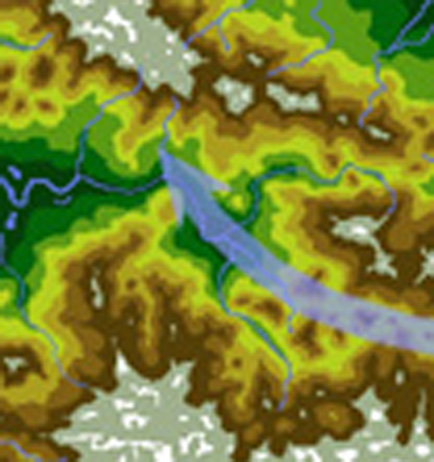
The Pagh tribe has been exploring the mountains on their quest to see why the Earth moves. In fact, they've been exploring so very many years that they've forgotten all about the reason they came here; all the remember is a vague cultural understanding that life is filled with Quests. Since the Players chose to reinforce the general notion that every tribe should have a medicine man (or woman), but had refused to characterize the earthquake with fanciful omens back in Year Zero, now it is tradition for the Abequa to be led by a strong warrior, and magic and mysticism are deprecated.
The tribe, now called Abequa, have come through a high valley, where food has been scarce. This is a way of life for them, rather than a transitory phase; discipline is strict so that nobody gorges on food or eats more than his share. All resources are carefully shared.
The leader for the Event in Round 2 is the warrior Bkesh (M), who rules and judges based on strength. He emphasizes competition, fitness, and survival, largely because their environment is so harsh and unforgiving. Those who cannot keep up the pace, or hunt their share, are left behind. The tribe is strong and brave, and they possess good tools, but they treat their magic-born children (those with the GURPS Advantage called Magery) as second-class citizens. Wizards are tools of the warriors, in essence, especially if they are physically weak. There is only one mage-talented member of the sparse Abequa tribe, and that is meek Jebba the Healer (F), daughter of the previous medicine woman Ezvat (now deceased).
There is an argument at hand which prompts the summoning of the Great Spirits. The tribe has long been accustomed to difficult survival in the high valley; it is their way. Everything changes when Ktope the Hunter (M) returns from a scouting expedition. Up ahead there is a valley where the trees grow all the way up to the sky, unlike the scraggly windblown twigs in the high altitudes. Animals are plentiful, he claims, and there is much to eat. Great beasts, like huge grazing cattle eighteen feet high, roam the river valley.
The tribe is on the verge of starvation and discipline may soon break down. Ktope promises to lead the tribe to this Valley. Bkesh sees this as a direct challenge to his leadership; in a land of plenty he will have less control over the people, less need for discipline. Ktope may be seen as hero or savior for leading the Abequa into this paradise.
In a struggle to maintain control over the tribe, and to prevent its usurpation by Ktope, Bkesh makes an announcement. "There shall be a feast tonight," he tells his people. "We shall go on a great hunt. Let us go prepare! For this hunt shall be an important test of our hunters. He who brings back the biggest animal shall be blessed and may have Jebba the Healer as his mate!"
Ktope sees Bkesh trying to solidify his political position, and doesn't allow himself to agree. "These beasts are gigantic," he warns. "Any wise hunter knows that you must first study the habits of your game. You do not slaughter them; you cull the weak and the sick, you learn their ways. We must be cautious, for this valley may contain great danger!"
What The Players Decided
They didn't like the sound of Bkesh, spotting him right off as an overbearing, dictatorial, controlling, bloodthirsty braggart. Under Bkesh the cavemen might easily depopulate the valley — one huaca literally had more meat on it than the tribe could eat before it spoiled, and Bkesh was proposing a wasteful killing competition. Not that they were pleased with Ktope, under whose guidance and pathological caution the old ways of starvation, conservation, and discipline would probably continue.
Wasn't there a middle ground? they wondered. And can't we do something about Jebba?
Solving both problems at once seemed like a natural to them, considering how much they were probably still stinging from the mistake of overly de-emphasizing religion in Year Zero. But before they arrived at that solution, they marched straight to the weaselly middle ground between the two viewpoints and set up camp* there.
"Can we teach them to preserve the meat?" asked Joe the Leader.
What with? I asked. The Great Valley is warm and dry; it gets almost no rainfall. The only water comes from fog, and from a massive river running through the valley. If they remained in the mountains they could use ice, or deep cold caves.
"What about salt?" he asked.
They're nowhere near the sea, so they can't set up evaporation pans, I pointed out. And unless you're going to get a starving tribe to mine for salt...
Salt preservation was out. How about magic? you ask. Well you may ask, but as I recall, it never occurred to the players to ask. It never came up, just as they didn't ask about curing meats with smoke. Perhaps magic was on their minds, because they started to dwell on poor second-class Jebba the Healer, medicine woman and also apparently chattel to be given away to the mightiest warrior.
"Did Bkesh say that the contest was only between himself and Ktope?" asked Dave craftily. "Could we make someone else the leader? Is there a toolmaker, for instance?"
There was a toolmaker for the tribe, I admitted. He hadn't been central to the political power struggle between Bkesh and Ktope, so I hadn't invented him specifically, nor given him a name, but I assumed there must have been one.
"Now, do I still remember how to make a cage from the last time?" Dave the Artisan asked, referring to the animals they had trapped for the Drim in Year 30K.
Sure, I said.
"Okay, so what we do is this," Dave said, and explained the plan. They would hold the hunting competition for all the tribe, with one twist: they had to capture a huaca alive. The winner would be leader and, to change the terms of the competition somewhat, could chose for a mate anyone in the tribe.
It's a deal, said the tribe. They were eager for the hunt and for the feast to follow.
Unknown to the tribe, the Players had already gone out to find a huaca and had fenced it in between some trees. They waited for the hunt to begin, passing the time by casting Beast Soother on their captured beast. Eventually, Dave returned with Jebba in tow. They taught her the Beast-Soother spell and told her it had all been arranged. Jebba would return with her animal and she'd be named leader. That's when the Players hit the first snag in their plan: they'd never asked Jebba if she wanted to be leader.
"I'm just a medicine woman," she said. "I'm not important enough to be leader."
"But," said Joe the Leader, "but ... you have to. It's for the good of the tribe. Only you can bring back this animal alive. If you don't, there will be no feast."
"Well, okay," she said reluctantly. "If I must. But I won't be very good at it."
Result
They brought Jebba and the huaca back in triumph. Jebba was named leader and had her choice of mates. The Eagle Clan of Abequa had their feast, and the rights of mage-born children had been restored.
That's when the Players realized the second snag in their grand plan. They'd also never asked Jebba whether she preferred either Bkesh or Ktope's plans. They'd just rigged a contest to install as leader a woman they knew nothing about...
*During that round it was only a camp. By now, of course, Dave the Artisan owns five-star accommodations, by reservation, operating under the name Weaselly Middle Ground LLC.
Tuesday, January 11, 2011
Year 30,000: The Mannut (Uman) Discover Mining

The various Uman tribes, by now called the Mannut, have been traveling in the mountains (aqua arrow, center). In Round 2, they are about to enter a period of isolation where their migrations do not take them within range of the other four clans. They shall be living in the mountains and passes, and farther north on the frozen tundra. Since the Players chose in Year Zero to save the child of Uman, and since they further assured them with a prediction that the child would grow up to be leader, many of the people of the Uman tribe have six fingers and toes.
While they are living in caves in the mountains, an earthquake drives them out of their cave. Nobody is harmed, but there is now a large vein of exposed ore in the bare rock, a bright orange colored ore with a green patina that wasn't entirely visible before.
Because in the previous round the players had denied any mystical explanation for earthquakes, and had further deprecated the use of mysticism overall — you don't need the Old Ways, Connor the Mystic had told them — the leader of the Mannut is Tukwa the Fox (M), a wily leader who will use whatever trick he must to gain advantage for the tribe. The wise woman, Nutah (F), is consulted occasionally, but her views are ignored as often as obeyed. Tukwa's chief enforcer is Gar the Spear (M). Discipline is good, and the clan's propensity for creative thinking and tool-making has been enhanced.
"Why did the earthquake destroy our cave?" the Fox Clan asks the Players, for this is the crisis for which the Players, now playing Great Spirits, were summoned.
"The earthquake came because Tukwa the Fox was seen near the orange metal in the cave wall," said Nutah the Wise Woman, largely in hopes that someone might listen to her for once. "The orange stones are cursed. We must abandon this place at once lest we anger the spirits."
"No," said Tukwa, a leader who had the makings of a true sophist. "The earthquake was a gift, a sign! By the shaking of the earth, this metal was given to us by the spirits, and we must make use of this gift."
"You were prying at the orange rocks," said Nutah accusingly. "You brought this upon us."
The people of the Fox Clan are suspicious of the rocks, frightened of the earthquake, and uncertain. The Players had to come up with an explanation.
What The Players Decided
First they realized that they had gone too far with their denunciation of mysticism in the previous round. They hadn't meant to shut down the development of magic, philosophy, learning, or understanding.
Dave the Artisan set about making something with the orange metal, quickly devising some kind of crucible that he might use in their fires.
While he was busy with that, Joe the Leader explained to the Mannut tribe: "The orange metal is not cursed. But Tukwa must learn to be careful, for the shining orange stone is mighty, and Nutah should have been with him. Only with strong medicine can these stones be handled safely."
"There," added Joe the Leader to Dave the Artisan. "That ought to secure a role in their society for the priesthood. We don't want them to give up on magic altogether."
"Good," said Dave. "I think I've got the hang of this copper. Now, I think we need to make something for them, some kind of ceremonial object. I could make a copper-tipped spearpoint for Gar the Spear."
"Hey, I want a copper spear too," said Connor the Mystic.
"You should make something shiny for Nutah, too. That's nicely symbolic," Joe the Leader said.
Like a necklace? I suggested.
"Yeah, a ceremonial necklace, I'll make something like that," said Dave the Artisan.
The Players presented the copper artifacts to the Mannut tribesmen, and Joe the Leader added a warning: "You are the only ones who have the secret over the orange stones," he told them. "So be careful. Other clans might come and try to take it away from you. The warriors must help to guard the mine."
Result
By prodding the Mannut tribe in the general direction of mining, they started a general theme of interest in geology within that region.
Because in the previous round the players had denied any mystical explanation for earthquakes, and had further deprecated the use of mysticism overall — you don't need the Old Ways, Connor the Mystic had told them — the leader of the Mannut is Tukwa the Fox (M), a wily leader who will use whatever trick he must to gain advantage for the tribe. The wise woman, Nutah (F), is consulted occasionally, but her views are ignored as often as obeyed. Tukwa's chief enforcer is Gar the Spear (M). Discipline is good, and the clan's propensity for creative thinking and tool-making has been enhanced.
"Why did the earthquake destroy our cave?" the Fox Clan asks the Players, for this is the crisis for which the Players, now playing Great Spirits, were summoned.
"The earthquake came because Tukwa the Fox was seen near the orange metal in the cave wall," said Nutah the Wise Woman, largely in hopes that someone might listen to her for once. "The orange stones are cursed. We must abandon this place at once lest we anger the spirits."
"No," said Tukwa, a leader who had the makings of a true sophist. "The earthquake was a gift, a sign! By the shaking of the earth, this metal was given to us by the spirits, and we must make use of this gift."
"You were prying at the orange rocks," said Nutah accusingly. "You brought this upon us."
The people of the Fox Clan are suspicious of the rocks, frightened of the earthquake, and uncertain. The Players had to come up with an explanation.
What The Players Decided
First they realized that they had gone too far with their denunciation of mysticism in the previous round. They hadn't meant to shut down the development of magic, philosophy, learning, or understanding.
Dave the Artisan set about making something with the orange metal, quickly devising some kind of crucible that he might use in their fires.
While he was busy with that, Joe the Leader explained to the Mannut tribe: "The orange metal is not cursed. But Tukwa must learn to be careful, for the shining orange stone is mighty, and Nutah should have been with him. Only with strong medicine can these stones be handled safely."
"There," added Joe the Leader to Dave the Artisan. "That ought to secure a role in their society for the priesthood. We don't want them to give up on magic altogether."
"Good," said Dave. "I think I've got the hang of this copper. Now, I think we need to make something for them, some kind of ceremonial object. I could make a copper-tipped spearpoint for Gar the Spear."
"Hey, I want a copper spear too," said Connor the Mystic.
"You should make something shiny for Nutah, too. That's nicely symbolic," Joe the Leader said.
Like a necklace? I suggested.
"Yeah, a ceremonial necklace, I'll make something like that," said Dave the Artisan.
The Players presented the copper artifacts to the Mannut tribesmen, and Joe the Leader added a warning: "You are the only ones who have the secret over the orange stones," he told them. "So be careful. Other clans might come and try to take it away from you. The warriors must help to guard the mine."
Result
By prodding the Mannut tribe in the general direction of mining, they started a general theme of interest in geology within that region.
Year 30,000: The Drim (Dar) Acquire A Telepath

For the past 30,000 years, the Dar (red arrow) have spreading out over the southeast. There are a multitude of Dar-related clans all over the Big River region. In this part of the world, they are called the Drim, for languages change over time (probably more than this, but I wanted things to sound recognizable to the Players).
Round 2 begins with a Gathering where the various clans of the Drim get together to exchange tales, hunt the giant water buffalo and trade knowledge. There is a matchmaking ceremony, of the same kind that the Players had set up in Year 0, where brides are exchanged between one Dar clan and another.
One of the promised brides is Temu (F, 15), the medicine woman for her tribe. However, at the Gathering, a scandal breaks out: Temu is rumored to be possessed by evil spirits! Without using magic at all, she can touch a person and know what he is feeling or thinking. She cannot be a medicine woman, say the other tribes: nobody would have her!
Her tribe’s leader and father, Vock the Tall (M), says she is a better medicine woman because she knows where it hurts. The other tribes at the Gathering are unconvinced.
The Council of the Drim get together and summon the Heroes, and make their plea. "Dispose of these evil spirits for us!" they beg the Players. "Kill her if you must, but drive the spirits away. We have tried the Old Rituals for driving away spirits, and they do not work!"
("Connor!" said Joe the Leader. "Thanks a lot. You told them to ignore the Old Ways. And improvise."
"Hey, it sounded like a good idea," Connor said.)
The Council of the Drim includes three people: Golm the Carver, the toolsmith to whom all toolsmiths bow, wise in the ways of spirits and craft. Cheb the Stick, the powerful hunter and disciplinarian, who has mastered the art of drawing maps in the dirt. Last is Ral the Raven (F), a healer ahead of her time. She thinks the evil spirits are in Temu’s head and they can be removed.
("I don't like the sound of that," said the Dave the Artisan.)
What The Players Decided
First, they decided to persuade the Gathering that Temu really was a better healer because of her power. "Prove it," said the Council of the Drim.
"Uh..." the Players said, never a good sign, and they immediately confabulated.
"We'll just bring some animal or something that's sick, and she can heal it, and that'll be that," said Joe the Leader.
"That just proves she can heal animals. They'll want to see she's better at healing people," argued Dave the Artisan.
"I can see to it that some of them need healing," said Joe grimly.
"We'll just hold some kind of contest. We'll get some animals — are there any animals around here that we could trap?" Dave the Artisan asked.
Yes, I said; there was a small proto-horse called the aguen, and a small ocelot-sized hunting cat.
"Hey, maybe we can get them to start domesticating animals," Dave said. "We'll get some of those."
What with? I asked.
Dave rolled a few dice, hoping to successfully invent the first animal cage. He succeeded, and the Players took a short expedition to go find some animals that they could use to test Temu's alleged healing prowess. (I noted with interest that they didn't actually test the assumption that Temu had any healing prowess. They were just going to stake their reputations on this ability sight unseen. Making assumptions could get them into trouble someday.)
Once two similar aguens were captured they could begin planning this healing demonstration. "All we need is for the animals to be injured equally," said Joe the Leader.
"Not equally. We want Temu to win," Connor the Mystic reminded him.
"And do we really want to encourage a tribe to go around maiming animals?" asked Dave. "We just want them to look sick."
The Players scrounged around for plants with a pharmacological effect, rather than physically injure them. They drugged both animals, one more heavily than the other, and presented them to both Temu and to Ral the Raven. Temu, of course, was to get the aguen who was less heavily medicated.
"We should test the effect of the plants," said Joe the Leader, who in Real Life is a nurse. "Then we can time how long the drugs last. Connor, how good is your Tell Time spell?"
"Uh ... I didn't take that one."
Boldly (because they had no choice) they proceeded with the demonstration. The two healers, Temu and Ral, sat down before their unfamiliar animal patients. Ral the Raven discerned that the animal had eaten something that didn't agree with it, and found some herbs she could use an emetic to make it vomit up all those lovely drugged leaves. Temu, meanwhile, had simply touched her aguen and sat back placidly, doing nothing.
"Not equally. We want Temu to win," Connor the Mystic reminded him.
"And do we really want to encourage a tribe to go around maiming animals?" asked Dave. "We just want them to look sick."
The Players scrounged around for plants with a pharmacological effect, rather than physically injure them. They drugged both animals, one more heavily than the other, and presented them to both Temu and to Ral the Raven. Temu, of course, was to get the aguen who was less heavily medicated.
"We should test the effect of the plants," said Joe the Leader, who in Real Life is a nurse. "Then we can time how long the drugs last. Connor, how good is your Tell Time spell?"
"Uh ... I didn't take that one."
Boldly (because they had no choice) they proceeded with the demonstration. The two healers, Temu and Ral, sat down before their unfamiliar animal patients. Ral the Raven discerned that the animal had eaten something that didn't agree with it, and found some herbs she could use an emetic to make it vomit up all those lovely drugged leaves. Temu, meanwhile, had simply touched her aguen and sat back placidly, doing nothing.
"Are you not capable of healing?" asked the jeering tribesmen at the Gathering.
"It isn't sick," Temu said. "It's sleeping."
The diagnosis was confirmed when Ral the Raven's aguen vomited up its narcotic salad. The tribesmen were convinced and the Players were off the hook.
As a finishing touch, Connor the Mystic taught Temu some magic spells to help her defend herself should her fellow clansmen again conclude that she was a evil soul-stealing witch. (That she might really be an evil soul-stealing witch apparently never occurred to him.)
As a finishing touch, Connor the Mystic taught Temu some magic spells to help her defend herself should her fellow clansmen again conclude that she was a evil soul-stealing witch. (That she might really be an evil soul-stealing witch apparently never occurred to him.)
Result
The Drim tribes of the Big River area would now have a strain of telepaths, and possibly other psionic or psychokinetic powers to come. Furthermore, they had been given a great big push in the direction of animal domestication, although it must be admitted that the players weren't asking me for domesticable animals for their demonstration.
Subscribe to:
Posts (Atom)